Many people choose a holster based on which design, carry method, and type is the “most comfortable.” While comfort is important, I like to think in different terms.
Step back for a second and consider the essential tasks of a holster. If you’re hardcore about your decision process, you’ll quickly conclude that comfort is a “nice to have” and not an “essential.” Don’t get me wrong; I’m all for comfort, but these three essential attributes of a great holster come first and foremost.
1. The best holster must keep your gun securely attached to your body, even during vigorous physical activity. Remember, a gun and holster are life and death tools, so you may be doing life and death things when you need them most.
2. The best holster must protect the trigger and firing controls of your gun. You need to be 100 percent confident it cannot go off ever until you make that so.
3. The best holster must maintain and present your gun consistently — every time. When you reach for your gun, after practicing that move thousands of times, your gun must be right where you expect it and ready in the proper orientation.
There are two honorable mentions to discuss, neither of which is an absolute essential.
First, a holster does help with concealment. But you can always dress around any holster style if you have to.
Second, it’s really nice if the best holster aces all the criteria above and is also comfortable to wear for hours on end.
Inside the Waistband
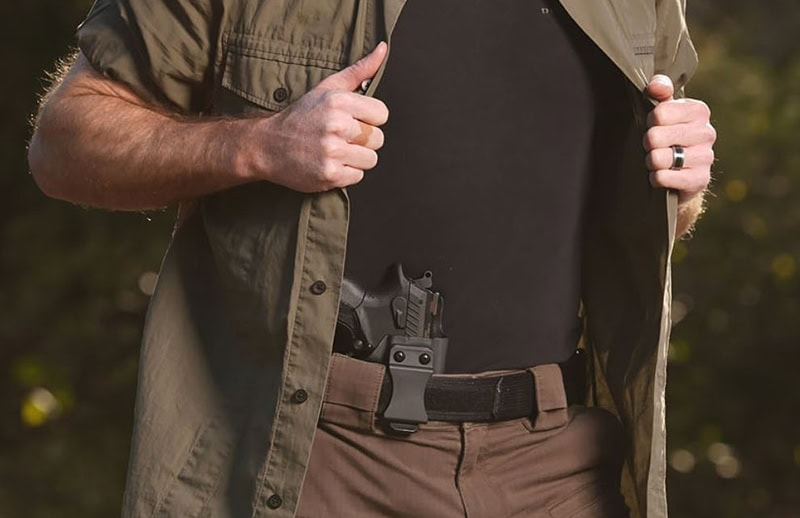
I’m an inside-the-waistband (IWB) carrier myself. If you’re not familiar, this means that the holster, and gun therein, mounts to the belt for stability, but the rig rides inside of your pants (or skirt for you ladies who carry IWB).
There are a few reasons for my choice.
I live in a warm climate that stays that way most of the year, so heavy clothing appropriate for concealment of an outside-the-waistband setup is a rarity. With IWB carry, most of the gun (and holster) is already hidden. The barrel and slide, trigger area, and, for revolvers, the cylinder, are, by definition of the IWB method, inside your clothing. So, for the most part, all you need to hide with clothing is the grip area. Since those rides above the belt line, you do not need extra-long shirts or jackets just to conceal the exposed grip.
A secondary benefit that is also included with the IWB method is extra gun security. With most of it tucked into your clothing, you get some extra retention and security benefit from the pressure and friction created by your pants and belt. The gun and holster are literally as close as they can be to your body.
IWB Holster Considerations
If you’ve narrowed down your choice to inside-the-waistband carry, you still have a couple of decisions to make.
You might have noticed you’ve got a full clock face of locations in which you can mount an IWB holster. Assuming your belt buckle represents the 12 o’clock position, the traditional placement (for a right-handed shooter, just reverse for lefties) is somewhere around the three to five o’clock position. Bodies vary, but for many, three o’clock is right on the hipbone, which can push the gun out more than necessary, so most opt for right behind the hipbone. There’s a natural “pocket” back there that allows your natural body contour to help hide the gun grip. A good holster will also help draw the gun grip in toward the body, so the bottom of the grip doesn’t “poke out” your cover shirt or jacket.
A couple of other considerations come into play. While the IWB method helps with security from belt and pants pressure, you’ll still want to make sure your choice uses quality belt clips. Ideally, those clips will be stuck on your belt until you very deliberately remove them from your belt. Think about all the daily activities that will exert pressure here: sitting down and standing up, getting in and out of cars, and walking, just to name a few. And of course, the possible physical nature of a self-defense situation.
While IWB carry helps with gun retention, you may feel more comfortable with a holster that offers an additional “active” retention feature. A good one will have a pressure (retention) adjustment to squeeze the gun more in the holster, but some models also offer a snap strap that goes over the slide or hammer to physically lock the gun into the holster. To draw, the operator must first release the strap. We call these thumb break holsters.
Again, intentionally last, is comfort. Not that it isn’t important. It’s just less important than the features that may keep you alive. Kydex or Carbon Fiber holsters can be thinner, so there’s less to tuck between your pants and body. On the other hand, nylon & leather holsters, while a little thicker, are often more comfortable. The tradeoff is your choice!