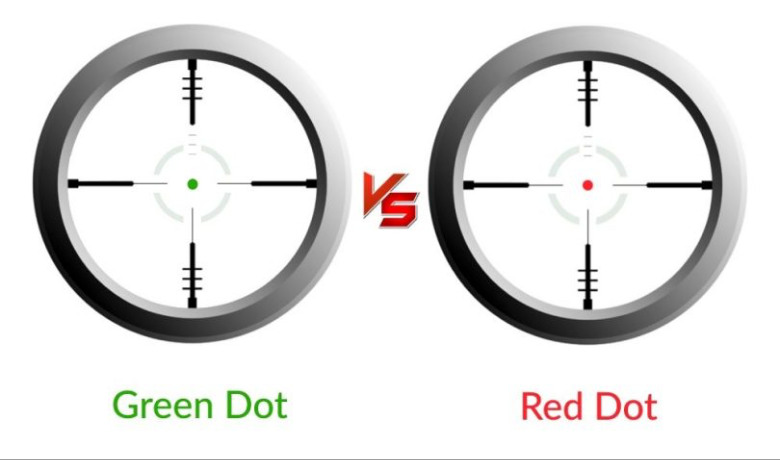
The aim here isn’t to dive into heavy technical jargon, but to give straightforward answers to a couple of increasingly common questions: what’s the real difference between a red dot and a green dot, and which one should you choose?
Reflex and holographic sights often offer both color options, though many models stick with just one typically red. While there’s plenty of information floating around on this topic, much of it is repetitive, shallow, and not particularly useful.
If you’re tired of wading through confusing talk about rods, cones, and conflicting claims, you’re in the right place. The most effective way to grasp the difference is to try a dual-color sight yourself. The next best option? Keep reading this article.
Green dots got a bit of a bad rap because the market was flooded by a bunch of cheap knock-offs that used green instead of the standard red color, but there are real differences between a green dot and a red dot that can make either one a better tactical choice in certain situations.
Visibility
Human eyes see green better than they see red. On the visible light spectrum, red is on the far edge of what our eyes can detect, while green is almost smack dab in the middle. In short, seeing red stresses out the eye more, while green is the comfort zone.
This would make a big difference if you were standing in a room with all four walls painted red or all four walls painted green. With a tiny little dot that is illuminated to your comfort level, the difference here is not substantial. Green may technically be a little easier to see, and you may be able to conserve some battery life by not having it as bright, the difference is not going to help you save for your next gun.
Night Vision
Green dots can be used for night vision sometimes. Night vision relies heavily on the color green to keep things visible, and while sometimes this means that green shows up amazingly well through your night vision devices (NVD), sometimes (as is the case with ANVIS lenses) the green won’t show up at all. The only way to know for sure about your combination of green dot and night vision is to talk to the manufacturers and find out.
When To Choose
Because our eyes generally have an easier time seeing green than red, green can work well during the day, especially if you don’t have an etched reticle (which most dot sights will not). If you’re shooting during the day and have a hard time seeing your red dot, you may want to try switching to green and see if it’s better. Of course, if you are in a forested or another area that’s dominated by green, then that may not work as well.
Pros
- Easier to see, can be good for astigmatism
- Better for daylight use
- Can usually be used for night vision
Cons
- Can’t always be used for night vision
- May have too much contrast for low light condition
Red dots are classics. Even though reflex and holographic sights come with many other colors besides red, they are all collectively referred to as red dots. There is some science involved with why red dots have become so dominant, but the real, simple reason is that red doesn’t occur in nature nearly as often as shades of green, yellow, brown, and blue.
Visibility
As mentioned above, technically the color red stresses out your eyes more than any other color besides pure blue, but we’re not talking about filling up your entire visual field with the color red for hours on end; we’re talking about a tiny dot that you’re mostly looking beyond to your target anyway.
That said, if you have astigmatism or some color-blindness, then a red dot may not be crisp, clean, or easy to see at all. Red contrasts really well with blues and blacks, so the red will be highly visible at night and in other low-light conditions.
Night Vision
The color red is theoretically compatible with night vision devices, but you have to be careful when combining a red dot and an NVD. Make sure to only use red dot sights that are advertised as night vision compatible and have at least two night vision settings on their illumination. Having a red dot that is too bright can actually ruin your night vision device.
When To Choose
Red dots are great for visibility when you are shooting in low-light conditions. In most cases, they will be better than green dots. Reds can also work just fine during the daytime if the brightness can go high enough on your sight. For shooters without any eye issues or problems, red works great in the vast majority of situations.
Pros
- Works with night vision
- Good for low light shooting
- Can be brightened for use in daylight
Cons
- May cause more eye strain
- May shorten battery life
Alternate Colors
There are other color options besides green and red; Holosun has their “gold” reticle that is designed for color-blind shooters and has other advantages, while UTG has a line of optics with 36 different color options all across the visible spectrum. Red and green are the workhorses and will be best for most situations, but there is always a place for other colors as well.