Investigators are working to reconstruct the events surrounding Monday’s mass shooting in Manhattan, focusing on how the suspect, a Las Vegas resident, obtained his firearms despite Nevada’s stringent gun control measures.
Authorities identified the gunman as 27-year-old Shane Devon Tamura. He was armed with an M4-style semiautomatic rifle and a .357 caliber revolver during the attack, according to law enforcement sources. Officials confirmed that the revolver had been legally purchased.
Investigators also noted that Tamura possessed a concealed weapons permit issued in Nevada. However, questions remain regarding the origin of the rifle, which played a central role in the incident and whose acquisition has not yet been clarified.
New York state law prohibits the transportation or possession of assault-style weapons.
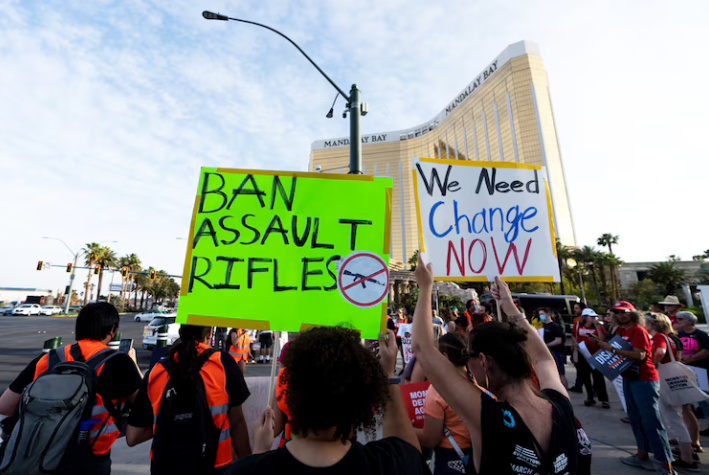
In contrast, Nevada does not impose such a ban. However, since the tragic 2017 Las Vegas mass shooting that claimed 60 lives and left hundreds injured, the state has implemented a series of measures designed to restrict firearm access for individuals deemed a risk to themselves or others. According to David Pucino, legal director and deputy chief counsel at the Giffords Law Center to Prevent Gun Violence, these reforms reflect Nevada’s effort to strengthen public safety while balancing gun ownership rights.
“He explained to ABC News that, in their latest state-by-state report card, Nevada received a grade of B- for its gun laws.”
Here is a breakdown of Nevada’s gun laws.
Background checks
Nevada is an open carry state for both firearms and larger rifles and shotguns. Any adult over 18 can purchase a firearm without a permit.
In 2020, a law was enacted that required all private firearm purchases to undergo a background check.
Concealed carry permit
Nevada allows local law enforcement to give concealed carry permits to handgun users if they meet certain criteria.

In this Jan. 25, 2024, file photo, people inspect weapons at the American annual trade show for the shooting sports, hunting, outdoor recreation, and firearm manufacturing industries SHOT Show, which is an acronym for ‘Shooting, Hunting, and Outdoor Trade Show’, in Las Vegas.
Mostafa Bassim//Anadolu via Getty Images, FILE
Under Nevada law, handgun owners must be at least 21 years of age, successfully pass a background check, and complete a certified firearm safety course.
Applicants for a concealed carry permit are barred from approval if they have a criminal conviction, are currently on parole, have been voluntarily or involuntarily committed to a mental health facility within the past five years, or have a documented history of habitual alcohol or drug use.
Restricted Locations While Nevada permits open carry, state law designates several areas where firearms are strictly prohibited. Gun owners may not bring weapons into public schools, government buildings such as courthouses and jails, or any business that posts clear signage banning firearms.
Conversely, firearms are permitted in hospitals, places of worship, sports arenas, and public parks, provided these locations do not display signage prohibiting them.
Extreme Risk Protection Order In 2019, Nevada enacted its version of a “red flag” law, formally known as the Extreme Risk Protection Order. This law empowers courts to temporarily remove firearms from individuals who have been proven to pose a danger to themselves or others. Petitions can be filed by law enforcement, family members, or household members, and must demonstrate to a judge that the individual presents a credible risk. If approved, the subject of the petition retains the right to appeal the order.
Firearm Prohibitions for Mental Health Issues Nevada law prohibits firearm ownership for anyone who has been adjudicated as mentally ill or committed to a mental health facility by a court in any state. Additionally, concealed carry permits cannot be issued to applicants who have been voluntarily or involuntarily admitted to a mental health facility within the five years preceding their application.
Device Safety and Storage While Nevada does not mandate secure storage of firearms when not in use, the state passed legislation in 2023 requiring licensed gun dealers to provide locking devices with each firearm sale. Dealers must also display signage informing buyers that negligent storage of a firearm may result in imprisonment or fines.
Ghost Guns In 2022, Nevada joined 14 other states in banning “ghost guns”—firearms without serial numbers that are often sold as kits for self-assembly. Law enforcement has flagged these weapons as untraceable, making them particularly concerning in criminal investigations.
Training and Responsible Ownership Understanding these laws is only part of responsible firearm ownership. Proper training ensures that gun owners not only comply with regulations but also practice safe handling, storage, and situational awareness. Organizations such as Condition Zero Tactical provide certified courses and concealed carry training that help individuals meet state requirements while promoting responsible use. Their programs emphasize safety, legal compliance, and preparedness—critical skills for anyone seeking to exercise their Second Amendment rights responsibly in Nevada.